Key Takeaways
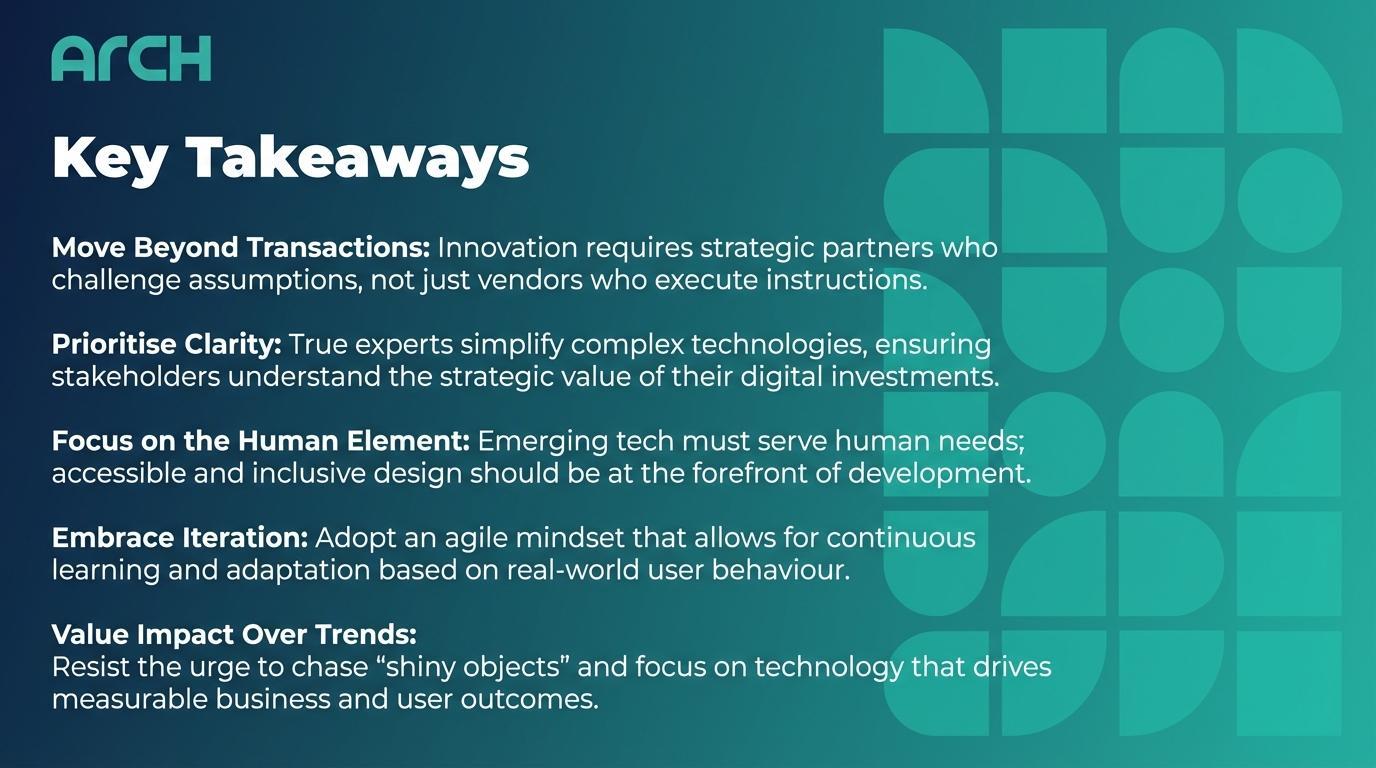
Move Beyond Transactions: Innovation requires strategic partners who challenge assumptions, not just vendors who execute instructions.
Prioritise Clarity: True experts simplify complex technologies, ensuring stakeholders understand the strategic value of their digital investments.
Focus on the Human Element: Emerging tech must serve human needs; accessible and inclusive design should be at the forefront of development.
Embrace Iteration: Adopt an agile mindset that allows for continuous learning and adaptation based on real-world user behaviour.
Value Impact Over Trends: Resist the urge to chase “shiny objects” and focus on technology that drives measurable business and user outcomes.
The New Complexity of Digital Growth
The pace of technological advancement is no longer just rapid; it is relentless. From artificial intelligence and machine learning to the intricacies of blockchain and spatial computing, businesses are bombarded with new tools daily. The challenge is no longer access to technology, but the ability to contextualise it.
For many organisations, this abundance creates a “complexity trap”. Decision-makers often feel pressured to adopt the latest trend to remain competitive, often without a clear strategy for how it serves their end-users. This reactive approach leads to wasted budget and disjointed user experiences.
To navigate this landscape, businesses must shift their mindset. The goal is not merely to acquire technology but to understand it. This requires a move away from transactional outsourcing toward deep, collaborative partnerships that prioritise human-centred outcomes.
Why Transactional Relationships Fail Innovation
In the past, the client-vendor relationship was simple: a business defined a requirement, and a vendor built it. In an era of emerging tech, this model is fundamentally flawed. It assumes the client already knows exactly how to solve a problem that might not have existed five years ago.
Innovation requires room for exploration and challenge. A transactional vendor will build exactly what is asked for, even if the premise is flawed. A strategic partner, however, will analyse the underlying business goal and the user need before writing a single line of code.
This is where the distinction in service becomes critical. It is tempting to view technical implementation as a commodity. However, selecting app and website developers who act as distinct strategic partners allows businesses to bridge the gap between technical possibility and practical application.
Demystifying Technology Through Accessibility
True expertise is not demonstrated by using complex jargon, but by the ability to simplify the complex. Expert partners play a crucial role in “demystifying” the black box of development. They translate heavy technical concepts into clear business value.
This transparency is essential for human-centred growth. When stakeholders understand why a technology is being used—and its limitations—they can make better strategic decisions. It shifts the dynamic from “trust us, it works” to a shared understanding of the product roadmap.
Furthermore, accessibility extends to the end-user. Emerging tech has the potential to alienate users if not implemented with empathy. Collaborative partners ensure that innovation improves accessibility and inclusivity, rather than creating new digital barriers.
The Pillars of Impact-Driven Partnerships
Successful collaboration in the tech sector relies on a few core behaviours. Firstly, there must be radical transparency. Both the client and the digital partner must be open about capabilities, timelines, and the definition of success.
Secondly, there must be an iterative mindset. Agile development is not just a project management buzzword; it is a philosophy of continuous improvement. Expert partners help clients become comfortable with releasing, measuring, and optimising.
Finally, the focus must remain relentlessly on impact. Every feature, integration, and design choice must be weighed against its ability to deliver value to the human at the centre of the experience. Technology is the vehicle, not the destination.
Conclusion
The future of digital growth belongs to those who can tame complexity. As technology continues to evolve, the businesses that thrive will not necessarily be those with the largest IT budgets. Instead, they will be the organisations that foster strong, collaborative alliances with experts.
By choosing partners who value transparency and human-centred design, companies can turn emerging technology from a source of anxiety into a powerful engine for growth. The collaborative advantage lies in realising that while technology is complex, the mission to serve people should remain simple.
About the Author
Hamish Kerry is the Marketing Manager at Arch, where he’s spent the past six years shaping how digital products are positioned, launched, and understood. With over eight years in the tech industry, Hamish brings a deep understanding of accessible design and user-centred development.
Frequently Asked Questions
1. What is the difference between a tech vendor and a tech partner?
A vendor typically executes a specific task based on a fixed brief, often transactionally. A partner is involved strategically, helping to define the problem, challenge assumptions, and navigate the project’s direction to ensure long-term business impact.
2. How does human-centred design apply to B2B technology?
Even in B2B settings, the end-users are people. Human-centred design ensures that complex enterprise software is intuitive, efficient, and accessible, which reduces training time and increases adoption rates among employees and clients.
3. Why is “demystifying” tech important for business leaders?
When leaders understand the capabilities and limitations of technology without the jargon, they can make informed investment decisions. It prevents wasted resources on trends that do not align with the company’s core strategic goals.
Sources
McKinsey & Company: The human factor in AI-based transformations