Choosing a technology partner is one of the biggest decisions in large-scale initiatives.
For complex digital projects, companies need more than coding capacity — they need a partner who takes ownership of the entire lifecycle.
In the following sections, we explain what full-cycle development involves, list the key criteria for evaluating potential partners, and look at several providers with strong track records in enterprise environments.
What Full-Cycle Development Means
Full-cycle development is when one company takes charge of the entire process for a digital product — strategy, business analysis, technical architecture, design, implementation, deployment, and continued maintenance afterward.
Unlike projects divided between several disconnected vendors, this keeps all work internal. The team retains a complete understanding of the initial goals, technical trade-offs, and business rules.
That reduces delays from miscommunication, allows faster iterations, and delivers software that works today, scales when needed, meets security standards, and supports long-term business plans — applicable to new products or legacy system upgrades.
Top Providers for Complex Project Delivery
The following companies meet the criteria discussed earlier. Each has delivered full-cycle projects at scale and worked across multiple industries. Their profiles include background, approach, and key services.
Avenga
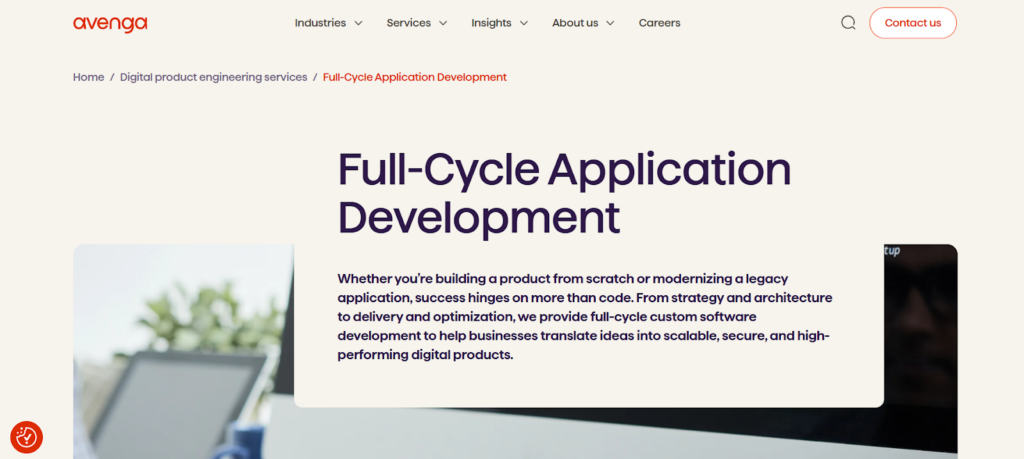
Avenga is a global IT consulting and software engineering company. They help big enterprises build new digital products or update old systems — making sure everything is secure, scalable, and actually works well. They handle the full process: from strategy and architecture to delivery and launch.
Avenga Full-Cycle App Development has been around for over 30 years, employs more than 6,000 people, and works with over 600 clients. That size and experience let them take on large, critical projects without major issues.
Their work emphasizes cloud-native design, security, and scalability. Avenga offers development, ongoing maintenance, and technology consulting to keep applications aligned with business needs.
Key services:
- Enterprise Applications: Design + development + ongoing support of scalable digital platforms that improve speed and flexibility inside the organization.
- Cloud-Native Development: Building applications with microservices, containers, and DevOps practices — focused on real scalability and shorter time-to-market.
- Legacy Optimization & Modernization: Updating or re-architecting outdated systems to reduce running costs and eliminate accumulated technical debt.
- Web & Mobile Development: Cross-platform experiences designed around the user, with strong performance and full accessibility compliance.
- UI/UX Development: High-fidelity prototypes and consistent design systems that connect visual choices to actual business logic.
- Security & Compliance-First: Security controls and all necessary compliance rules integrated right from the initial design phase.
JoinToIT

JoinToIT builds custom software. Full-cycle development—from the initial concept through to a finished product and whatever comes after. Eleven years in business, more than 500 projects delivered. They focus on practical solutions that solve actual business problems, not just writing code.
Clients get full visibility into what’s happening. The company maintains a high level of communication and transparent reporting throughout development.
Engagement models are flexible. Need to scale your team up or down? They make that easy. Before building anything, they take time to understand each client’s business at a foundational level. This way, the solutions they deliver actually align with strategy and drive real value.
Key services:
- Web & Mobile App Development: Building dynamic websites and secure, intuitive iOS and Android applications.
- UI/UX Design: Transforming visions into user-friendly products through deep audience research and innovative design tools.
- QA & Testing: Ensuring reliability through manual and automated testing methodologies.
- DevOps: Accelerating delivery with expert engineers focused on efficiency and scalability without compromising security.
- Dedicated Teams: Offering staff augmentation to scale teams with skilled developers, designers, and engineers.
- Cross-Industry Expertise: Serving diverse sectors including Banking & Finance, Healthcare, Logistics, Retail, and Government.
Soloway

Soloway has operated as a full-cycle software engineering firm for more than 17 years and delivered over 1,500 projects. They manage all phases internally — discovery, planning, coding, deployment, and continued support. Keeping it all under one roof avoids the usual overhead of coordinating with different outside providers.
They build IT architectures that remain reliable under significant operational demands and allow for simple scaling later. Projects are preceded by in-depth business analysis and detailed domain research to confirm strategic fit and long-term adaptability instead of short-term solutions.
Soloway has practical knowledge of integrating blockchain, IoT, and big data analytics into enterprise environments where those tools address actual business needs.
Key services:
- Custom Websites & Mobile Development: Building platforms from the ground up, always starting with a discovery phase to define business goals.
- Customer Experience Design: Comprehensive UX/UI and CX design audits, from concept to implementation and testing.
- Business Analysis: IT transformation consulting focused on improving entire systems, not just individual elements.
- Cutting-Edge Technology Integration: Expertise in Blockchain, Data Science & Big Data, IoT, and AR/VR to create future-ready solutions.
- Project Management: Ensuring sustainable, non-disruptive integration of solutions for effective results.
- Comprehensive Platform Development: Experience building a wide range of solutions, including CRM, CMS, ERP, and LMS platforms.
ELEKS

ELEKS began in 1991, providing software engineering plus consultancy services. Their clients include big corporations, smaller businesses, and companies trying to disrupt their markets.
Team background is mostly engineering, math, and physics, which means they tend to solve things with solid analysis and technical depth. Result for customers: faster delivery of products/services and reduced costs across different sectors.
Services range from deep technical work (cloud infra, AI builds, data platforms) to advisory stuff (cybersecurity structures, agile implementation, sustainability consulting). That combination allows proper backing for companies during complicated, make-or-break digital changes — way beyond just providing coding teams.
Key services:
- Engineering: Full-cycle dev, PoC, cloud, ERP/CRM consulting, legacy modernization.
- Advisory: Product strategy, cybersecurity, feasibility studies, sustainability, and end-to-end agile.
- Data & AI: GenAI/ML solutions, data science, MLOps/LLMOps, data engineering, automation.
- Optimisation: Audits, QA, support, FinOps cloud optimization.
- Industries: Finance, Insurance, Healthcare, Pharma, Logistics, Automotive, Energy, etc.
Selection Criteria for Enterprise Projects
Enterprise projects come with higher stakes than most. Picking the right development partner takes more than looking at a portfolio. There are specific things large organizations need to check before making a decision.
Technical Expertise & Architectural Prowess
The partner must show experience with complex architectures — microservices, cloud-native development, legacy integration. They need knowledge of current languages, frameworks, and agile processes.
The product should handle high loads and scale without major redesigns.
Security and Compliance-First Approach
For enterprises, security is not optional. The right partner builds with security and compliance in mind from day one, not as an afterthought.
They need to know industry regulations like GDPR, HIPAA, or SOC2 and have a track record of delivering applications that are both secure and resilient.
Strategic Consulting & Business Acumen
A vendor should do more than execute tasks. They need to act as a strategic partner. That means they can audit existing systems, offer technology advice, and make sure the technical work lines up with broader business goals. The solution should actually drive value, not just check boxes.
Service Coverage
Complex projects need multiple capabilities beyond coding. The right partner includes UX design, testing, DevOps processes, and long-term maintenance under the same roof. This approach maintains quality control and minimizes risks from working with several external providers.
Track Record & Stability
Enterprises require partners with established experience. Long operational history, a capable team, and proven success with large-scale, ongoing projects indicate the stability required to support essential systems over time.
Closing Remarks
Complex enterprise projects tend to work better when one partner handles the full development lifecycle. That is why it helps to understand what full-cycle development involves and how to evaluate vendors.
We cover companies that have the real track record and full service range needed for mission-critical projects. If your business wants to manage risk properly and hit long-term goals, we believe that kind of proven capability is what you should look for.