The PvP format called Arena is one of the hardest activities in World of Warcraft. It may sound simple at first glance – just put two or three people on a small map to play against the other similar team and try to beat them. But the actual WoW Arena requires knowledge about cooldowns, positioning, pressure timings, crowd control, and teamwork.
And this is exactly why many newcomers reach a certain level in their development and get stuck at it. The problem is that they usually do not have any specific mistakes — it’s rather a combination of ineffective teamwork, subpar defensive plays, choosing the wrong targets, and a lack of understanding about how the rating works.
In this WoW Arena Beginner Guide, we will explain the systems of progress within the format of PvP in WoW.
What Is WoW Arena and Why Does It Matter?
Arena is a rated PvP format that focuses on quick and decisive team fights. In contrast to battlegrounds, where the objectives and team sizes make up for mistakes, everything becomes visible in Arena. By overlapping defensives, chasing, breaking crowd control, and missing opportunities, you will pay very soon for any misplays. There are 20 WoW Arenas in total, and they rotate randomly when you queue for one of the available arena modes.
Arena 2v2 teams are usually preferred by new players, simply due to the easier reading of information. There are fewer opponents to track and cooldowns to see on the screen, as well as more room for exploring your class mechanics. Nevertheless, 3v3 is still the standard format for serious Arena development. It demands much more precise coordination and knowledge, but it teaches the game mechanics deeply.
Rated PvP also involves several other formats, such as Solo Shuffle or large rated games. They help you develop under pressure, experiment with specs, and find out their pros and cons. At the same time, traditional Arena is still the most efficient learning platform for class synergy, coordinated crowd control, and effective cooldown trading.
📌 It is possible to see the difference between all the mentioned types of PvP from the leaderboard in the public PvP section.
How WoW Arena Rating Works for Beginners
The most reliable way to detect the skill level of an Arena player is to look at their rating. The system is built in a way that is not just a number that moves after every win or loss. In fact, it reflects your visible progress, while matchmaking also considers hidden team strength. That is why two wins may not always give the same rating gain. And in turn, one loss against a lower-rated team can hurt more than expected.
Beginners should understand three basic concepts:
- CR, or current rating, shows your visible ladder position.
- MMR, or matchmaking rating, influences the teams you face.
- Win rate matters over time, not just during one lucky session.
The PvP system in WoW considers multiple aspects that affect your rating to efficiently evaluate your actual skill. Teams that win 7 out of 10 games in a series of evenings will rise faster than teams that win one game very well but then fall off. This is why highly skilled players consider Arena as an endless cycle of improvement rather than a rating race.
Rating also determines rewards. In-season PvP rewards may consist of transmogs, weapon illusions, titles, mounts, and other status symbols. Rewards differ each season but follow the same pattern: good results lead to more achievements in both appearance and competition. Currently, in-season PvP rewards are based on this same rating system.
Why Beginner WoW Arena Players Get Stuck
The primary reason why most new Arena players get stuck is that they do not know when damage and timing matter. Thus, pressing every offensive CD into full enemy defensives rarely creates pressure. Likewise, chasing a healer behind a pillar can ruin your positioning and lead to a lack of DPS. Also, using two of your major defensives at once can leave you and your team helpless thirty seconds later.
In addition to these points, the most common beginner mistakes include:
- overlapping defensive cooldowns with teammates;
- using crowd control without a kill plan;
- swapping targets too late;
- ignoring enemy offensive cooldowns;
- fighting in bad positions;
- blaming the comp instead of reviewing mistakes.
After a series of preventable mistakes and losses, many newbies feel exhausted and unwilling to continue. This is also where many players start looking for outside help. Some want coaching, some want a stronger teammate for practice, and others want a planned push toward a reward bracket. Luckily, a properly organized WoW Arena Boost can fit that situation when the goal is clear, the process is transparent, and the player understands what they want from the session.
What you should remember and what really matters is context. The idea is that arena assistance should not be like getting paired randomly with someone who is better than you. It should be more systematic, with defined objectives, bracket selection, a schedule, and communication.
Arena Formats: 2v2, 3v3, and Solo Shuffle
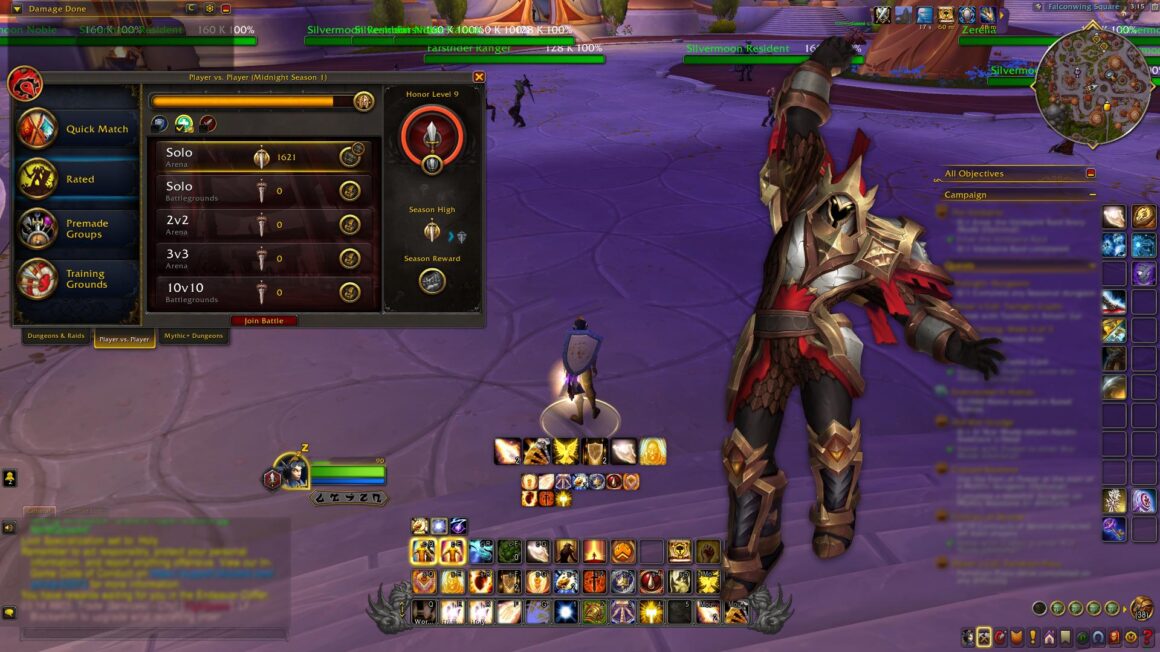
Each Arena format teaches different skills. Beginners often treat them as the same mode with different team sizes, but that is not quite true.
|
Arena Format |
Best For |
Main Challenge |
|
2v2 |
Learning basics, matchups, and survival |
Some comps are very matchup-dependent |
|
3v3 |
Serious teamplay and coordinated pushes |
More cooldowns, more crowd control, faster swaps |
|
Solo Shuffle |
Fast practice and personal adaptation |
Unstable teammates and changing rounds |
|
Skirmishes |
Low-pressure warm-up |
No real ladder structure |
2v2 is great for learning your class. You get more time to see enemy cooldowns, understand healing pressure, and practice positioning. Double DPS comps can teach aggression, while healer-DPS comps teach pacing and dampening.
3v3 is the real test of team coordination. You need clean crowd control chains, planned offensive goes, and strong defensive calls. One player can start pressure, another can extend control, and the third can secure the kill.
Solo Shuffle is useful for repetition. It forces you to adapt quickly because the teams change across rounds. However, it can also build bad habits if you play only for personal damage and ignore team setup.
How Pro Players Think About WoW Arena
Strong Arena players do not see every match as chaos. They divide the game into windows. There are offensive windows, defensive windows, reset windows, and bait windows. Once you start thinking this way, WoW Arena becomes easier to read.
For example, a beginner may think, “We lost because their healer was too strong.” A better player asks, “Did we force the healer’s trinket before using our burst?” That small shift changes everything.
Good players usually track these things:
- enemy trinkets;
- major defensive cooldowns;
- healer positioning;
- crowd control diminishing returns;
- offensive cooldown timers;
- map control around pillars;
- target mobility tools.
This does not mean beginners need perfect awareness from day one. Instead, they should start with one habit at a time. Track trinket first. Then track major defensives. Then learn when your team can safely push in.
Team Composition and Class Synergy in WoW Arena
A strong Arena comp is not just three powerful specs placed together. The best teams have a clear win condition. Some comps win through burst setups. Others win through rot pressure, mana pressure, or repeated crowd control chains.
Beginners should ask three questions before choosing a comp:
- How does this team kill?
Does it win with burst, dampening, swaps, or constant pressure? - Who starts the crowd control chain?
A comp with no clear setup often wastes its strongest cooldowns. - How does the team survive enemy burst?
If every player needs help at the same time, the comp may collapse under pressure.
Class balance changes every season, but synergy rules stay stable. A spec with strong burst pairs well with reliable crowd control. A fragile caster needs teammates who can peel. A melee cleave needs ways to stay connected to targets.
📌 This is why copying a top ladder comp does not always work for beginners. The comp may be strong, but only if the players understand its tempo.
WoW Arena Cooldown Trading
Cooldown trading is one of the biggest differences between low-rated and high-rated Arena. Every team has offensive tools and defensive tools. The goal is to trade less while forcing more from the enemy.
Bad cooldown trading looks like this:
- enemy uses one offensive cooldown;
- your team panics;
- two players use major defensives;
- enemy waits;
- your team has nothing left for the next push.
Good cooldown trading is calmer. One player responds with the correct defensive. The healer saves trinket if possible. The team uses positioning to reduce pressure. Then, when the enemy has fewer tools, your team attacks.
A wow pvp arena boost often works best when players watch how experienced teammates trade cooldowns. The value is not only the rating. It is seeing what a clean defensive response looks like in real games.
WoW Arena Crowd Control and Diminishing Returns
Crowd control, or CC, wins Arena games when used with purpose. Beginners often press CC because it is available. Better players use it because the team is ready to create pressure.
The basic idea is simple. If you stun a kill target while your teammate controls the healer, the enemy team must respond. If you fear, cyclone, sheep, blind, or trap at random, the enemy may wait it out and lose nothing.
Diminishing returns make this even more important. Repeating the same type of control too quickly reduces its duration. That means a poorly timed stun can ruin the next kill attempt.
A simple beginner rule helps here: do not use major CC unless your team can gain something from it. That gain can be a trinket, defensive cooldown, kill pressure, or a clean reset.
WoW Arena Roles and Positioning
Positioning does not look flashy, but it decides many games. A player standing in the open gives the enemy team free pressure. A healer standing too far forward becomes an easy crowd control target. A melee player chasing behind a pillar may leave their healer unable to help.
Good positioning depends on your role:
- Healers should use pillars, avoid unnecessary CC, and stay close enough to recover teammates.
- Melee DPS should pressure targets without dragging the fight into terrible positions.
- Ranged DPS should create lines that allow damage while avoiding easy swaps.
- Hybrid specs should know when to help with off-healing, peels, or control.
A reliable pvp boost wow session should never ignore positioning. If the only plan is “do more damage,” the run may win some games but teach very little. Real improvement starts when players understand why they won or lost each exchange.
WoW Arena Gear, Talents, Addons, and Preparation
Sometimes players just queue to WoW Arena with no preparation, but this approach is actually wrong. Before the queue pops, you should already be fully geared, talents, macros, and keybinds set, UI clear, and addon setup is ready. All these aspects affect your ability to react under pressure.
Beginners should prepare these basics:
- full PvP gear for the current season;
- correct embellishments, enchants, and gems;
- PvP talents for common matchups;
- focus macros for interrupts and CC;
- arena target macros;
- party defensive tracking;
- diminishing return tracking;
- clear nameplates.
You do not need a professional UI to start. In fact, many beginners overload their screen with too much information. The better approach is simple: track only what you can actually use.
Start with trinkets, major defensives, and DRs. Add more once those become automatic.
WoW Arena Communication
Good Arena communication is short. Long explanations during a match usually come too late. Your team needs quick calls that describe intent.
Useful calls include:
- “I can stun healer next.”
- “No trinket on priest.”
- “I have wall, do not trade.”
- “Reset behind pillar.”
- “Swap mage after block.”
- “Big damage in ten.”
Bad communication sounds emotional. “Why did you do that?” or “Healer is trolling” helps nobody during the match. Save review for after the game.
A team that communicates clearly can beat mechanically stronger players. This is especially true at beginner and intermediate ratings, where many teams lose because they panic.
Arena Boosting, Carries, and Coaching: What Is the Difference?
Players often use these terms loosely, but they do not always mean the same thing.
|
Type of Help |
What It Usually Means |
Best Use Case |
|
Boosting |
Structured help toward a rating or reward goal |
Saving time during a seasonal push |
|
Carry |
Playing with stronger teammates who handle most pressure |
Reaching a specific milestone |
|
Coaching |
Learning decisions, matchups, and habits |
Long-term improvement |
|
Self-play support |
Player stays active on their own character |
Safer, more involved progression |
WoW arena boosting makes the most sense when the player has a defined objective. That might be a rating bracket, a transmog threshold, or a seasonal achievement. Without a clear goal, the service can feel vague.
A WoW arena carry is different. It usually means the stronger players create most of the win conditions. That can help with a specific target, but it may teach less unless the player pays attention.
The slowest yet most helpful option for beginners is coaching. It is slower, but it builds better habits. Thus, if you want long-term progress, coaching-style support often gives more value than raw rating alone, as you will not only get carried, but also learn how to actually play Arena in WoW.
Some players choose to buy WoW arena boost support before a season ends because they lack time to build stable teams. That can be reasonable, but only when the provider explains the process and avoids risky shortcuts.
What Makes WoW PvP Carries Different From Normal Arena Practice?
Normal practice is built around trial and error. You queue, make mistakes, lose games, talk it over, and improve. Carries focus more on reaching a defined result with stronger help.
This does not make one option automatically better. It depends on the goal.
If you want to learn your class deeply, regular practice and coaching matter more. For finishing a seasonal reward before the deadline, WoW pvp carries look more practical. So, the key is choosing the right tool for the right situation.
Beginner Arena Checklist
Before you start a serious climb, check the basics.
|
Area |
What to Check |
|
Gear |
PvP item level, enchants, gems, embellishments |
|
Talents |
Matchup-ready builds and PvP talents |
|
Macros |
Focus interrupt, focus CC, arena target binds |
|
UI |
Cooldown tracking, DR tracking, clean nameplates |
|
Communication |
Short calls for trinkets, swaps, defensives |
|
Strategy |
Clear kill target and crowd control plan |
|
Mindset |
Review losses without blaming teammates |
This checklist will not make you a high-rated player overnight. However, it removes many beginner problems before they happen.
When a World of Warcraft PvP Boost Can Be Useful
World of Warcraft PvP boost can be of great value when one understands the basics but lacks time, companions, or consistency. Not everybody can maintain their arena roster because Arena is a multiplayer mode. It means that even those players who know how to play may have problems due to uncoordinated team mates or time constraints.
The best way to approach any PvP boosting is to consider such help as additional assistance and not miracle. Proper equipment and some preparation will make things much more comfortable.
It is especially important for those players who would like to get seasonal rewards. While structured goals can give a sense of ease, understanding what is happening on the field is beneficial for the player anyway.
Final Thoughts
WoW Arena is difficult because it combines many skills at once. You need class knowledge, matchup awareness, positioning, communication, cooldown tracking, and emotional control. Beginners often focus only on damage, but Arena rewards players who understand timing.
The best way to improve is to treat every match as a learning opportunity. Ask what cooldowns were traded. Ask why a target survived. Ask where your healer stood. Ask whether your team had a real kill setup or just pressed buttons at the same time.
Boosting, carries, and coaching can all fit into modern PvP progression, but they work best when the player knows their goal. An arena boost WoW option is helpful if you are looking for help with time-sensitive rewards, while coaching can help you actually learn how to play PvP on your own. The most skilled players choose the format that matches their needs instead of expecting one solution to fix everything.
About the Author