For years, a firewall and antivirus were enough to feel safe. That era is over. Today’s attackers move at machine speed, generate brand-new malware on demand, and slip past tools built to recognize only what they have seen before. The result is a widening gap between the threats businesses face and the defenses most still rely on. Breach research shows that people are involved in 60% of breaches, and much of the damage is done by malware that slips past software already installed to stop it. Closing that gap is exactly where AI managed security comes in. This article explains why legacy defenses fall short and what a modern, AI-driven managed approach adds. The good news is that this is a solvable problem, provided defenders stop fighting today’s attacks with yesterday’s tools.
Key Takeaways
- Traditional antivirus relies on signatures and misses the novel, fast-moving threats attackers now use.
- The human element factors into most breaches, and plenty of malware slips past installed antivirus.
- Attackers now spread through a network in under an hour, faster than most in-house teams react.
- A managed, AI-driven model adds 24/7 monitoring, behavioral detection, and active response across the stack.
- Firms that lean on AI in defense save roughly 1.9 million per breach, IBM finds.
The Problem With Traditional Defenses
Traditional security tools are products you buy, install, and watch yourself. A firewall filters traffic, and antivirus scans files against a database of known threats. That model works against yesterday’s attacks, but it leaves three gaps: it only catches what it already recognizes, it usually protects just a single device, and it mostly runs during business hours. Understanding how AI managed security works starts with seeing where those gaps open up. Each gap on its own might look manageable. Together, they hand attackers a reliable playbook: strike outside the hours you are watching, with something your tools have never catalogued, aimed at a device they only half cover.
The table below shows the difference between the tools most businesses still lean on and a modern managed approach built on AI.
|
Capability |
Traditional tools |
AI managed security |
|
Detection basis |
Known signatures and rules |
Behavior and machine learning |
|
New or unknown threats |
Usually missed |
Flagged as anomalies |
|
Coverage |
One device at a time |
The whole environment at once |
|
Hours |
Mostly business hours |
Around the clock |
|
Response |
Raises an alert |
Detects, then contains |
Why Legacy Tools Miss Modern Threats
The core problem is speed and novelty. Signature-based tools can only stop a threat once someone has seen it, named it, and pushed out an update. Attackers now sidestep that entirely, using AI to generate fresh malware and convincing phishing faster than any signature list can keep up.
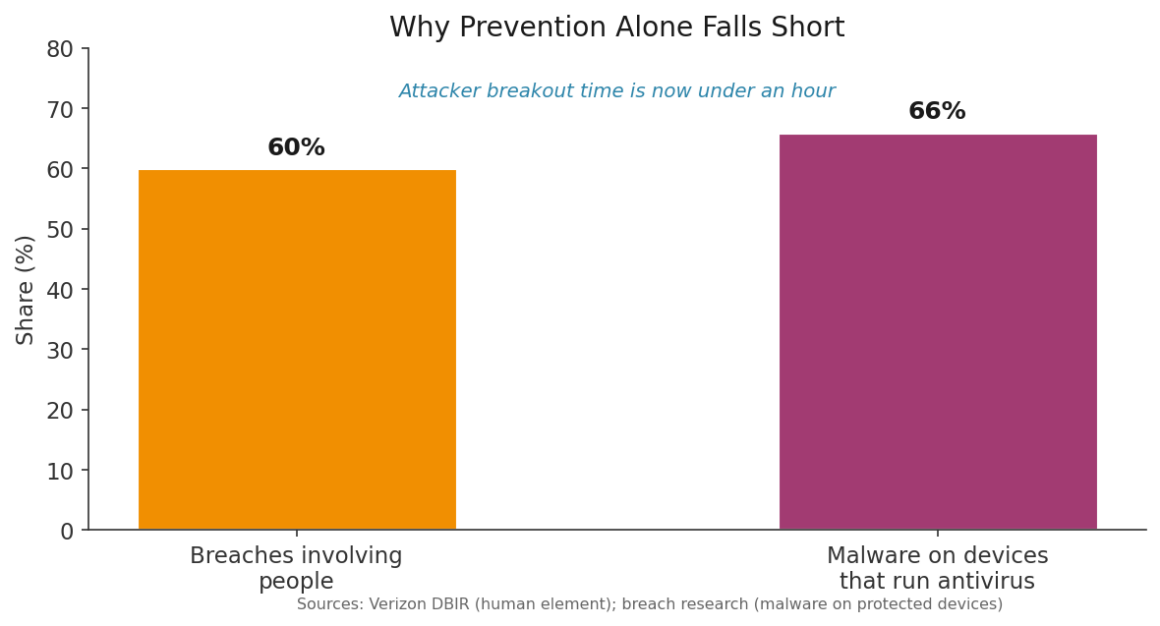
Prevention still matters, but it cannot catch what it has never seen.
The numbers are sobering. Most malware infections happen on devices that already run antivirus, and attacker breakout time, the window from first foothold to spreading, is now under an hour. For a broader view of how breaches actually unfold, the leading breach investigations report documents these trends year after year. The lesson is that prevention alone leaves too much room, so real resilience means pairing it with the fast, proactive, insight-led approach that spots trouble early. This is not a knock on prevention, which still blocks a huge volume of routine attacks. It is a recognition that prevention is only the first layer, and that the threats getting through are precisely the ones designed to evade it. That is a losing trade unless detection and response are watching for whatever slips past.
“The DBIR’s findings underscore the importance of a multi-layered defense strategy.” Chris Novak, Verizon Business
What AI Managed Security Adds
AI managed security is not just another product; it is a service pairing machine intelligence with human experts watching your environment around the clock. Rather than waiting for a known signature, it learns what normal looks like, flags what does not, and then acts.
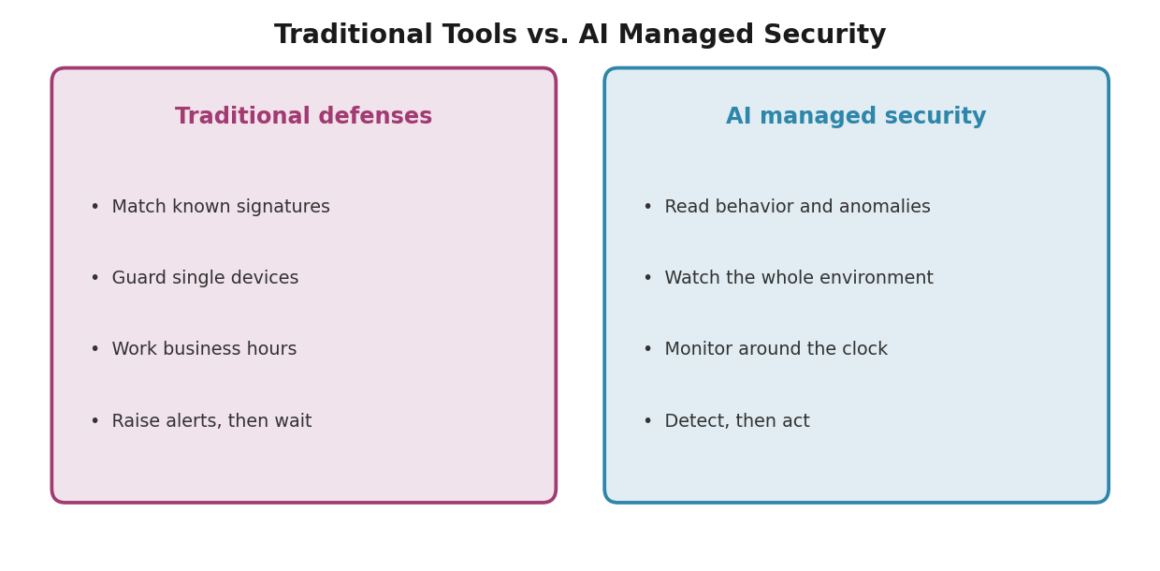
The shift is from recognizing the past to reading the present and responding.
Three capabilities set it apart. It correlates signals across endpoints, cloud, identity, and network, so it spots attacks that any single tool would miss. It runs at all hours, because threats do not keep an office schedule. And it moves from alert to action, isolating a device or blocking traffic in real time. Woven into a layered set of security solutions, it covers the gaps that stand-alone tools leave open. The effect is less noise and faster action. Instead of a small team sifting through thousands of alerts, most of which lead nowhere, the system surfaces the handful that matter and has often already begun to contain them.
|
Warning: a common mistake is treating AI as a full replacement for people. The strongest setups keep human analysts in the loop to validate findings, hunt for subtle threats, and make the calls that carry real consequences. |
The Business Case: Speed, Cost, and Coverage
The advantages are practical, not just technical. Standing up a full in-house operations center is expensive, often more than 700,000 dollars a year to staff and run, and the talent to fill it is scarce. A managed, AI-powered service delivers that capability instead.
|
Gap in traditional defense |
Why it matters |
|
No after-hours coverage |
Attackers strike nights and weekends |
|
Signature blind spots |
Novel and fileless attacks slip through |
|
Alert overload |
Real threats get lost in the noise |
|
Talent shortage |
Skilled analysts are scarce and costly |
|
Key stat: the payoff shows up in the numbers. Organizations that use AI extensively in their defenses save close to 1.9 million dollars per breach and contain incidents about 80 days faster, according to IBM. |
This short explainer walks through how this kind of managed service works in practice. For most small and mid-sized businesses, that math is decisive: they face the same threats as large enterprises but rarely have the budget or staff to counter them alone, which is exactly the gap a managed model fills.
Strong results still rest on solid foundations, so pair managed detection with sound organizational security measures such as access control and timely patching. Advanced detection layered over weak fundamentals still leaves doors open, so the two belong together.
Making the Shift
Moving to AI managed security does not mean ripping everything out. Start by mapping where your current tools leave gaps, then layer detection and response on top of the prevention you already have. Decide whether a fully managed or co-managed model fits your team, and make sure whatever you pick runs on the clean, AI-ready data these systems need to perform well. None of this has to happen overnight. A phased rollout, starting with the highest-risk systems, lets a team build confidence and prove value before expanding coverage across the business. The aim is steady progress, not a rip-and-replace project that stalls before it delivers.
|
Pro tip: before signing with any provider, ask how quickly they detect and contain a real threat, and how much of the response they handle for you. Outcome metrics like time to contain matter far more than a long feature list. |
Frequently Asked Questions
What is AI managed security?
It is a managed service combining AI-driven detection with human experts to monitor, detect, and respond to threats around the clock. In practice, it acts as an always-on extension of whatever team you already have.
Why do traditional antivirus tools fail?
They rely on signatures, so they only catch threats already identified. Attackers now produce novel and fileless attacks that no signature covers, and much malware slips past antivirus that is already installed.
Is this approach only for large enterprises?
No. It is often most valuable for smaller organizations, which gain enterprise-grade, around-the-clock protection without the high cost of staffing a full security team in-house.
Does AI replace security analysts?
No. AI handles scale and speed, but human analysts validate threats, hunt for subtle attacks, and make high-stakes decisions. The best models keep people firmly in the loop.
How do I start with AI managed security?
Map your current gaps, add detection and response onto existing prevention, and decide between a fully managed service and a co-managed one. Judge providers on their speed to detect and contain real incidents.
No Longer Enough on Their Own
Traditional defenses are not useless; they simply cannot stand on their own anymore. Firewalls and antivirus still block familiar threats, but they cannot see the novel, fast, AI-driven attacks that define the current landscape, and they cannot watch every hour of every day. AI managed security closes those gaps by pairing machine speed with human judgment, across the whole environment, without pause. The businesses that treat detection and response as essential rather than optional will contain incidents faster and spend far less recovering. More importantly, they can trust that someone, or something, is always watching. In a world of machine-speed attacks, that difference is everything.
About the Author