Most anime concepts start somewhere around here: “I want to create a mysterious anime character, but I do not know who the character is or where the scene takes place.”
That is a real starting point, but it is not yet a prompt. Writing a long prompt on top of an undecided concept usually produces a generic image, because the vague parts get filled in by the model rather than by you.
Clarifying first works better. Mio.2 can help with that stage, organising creative decisions through conversation instead of asking you to arrive with everything settled.
Below is a five-step process that turns AI prompt ideas from a fuzzy sentence into a specific, usable prompt.
Step 1 — Enter the Starting Idea
Begin with exactly what you have:
“I want to create a mysterious anime character, but I do not know who the character is or where the scene takes place.”
That sentence looks empty, but it already contains one usable element: a mysterious anime character. Mystery is a mood and a story posture. It suggests concealment, distance, something the viewer is not being told yet.
Everything else is undecided — the role, the location, the action, the framing, the lighting. That is fine at this stage. Those gaps are what the next step is for.
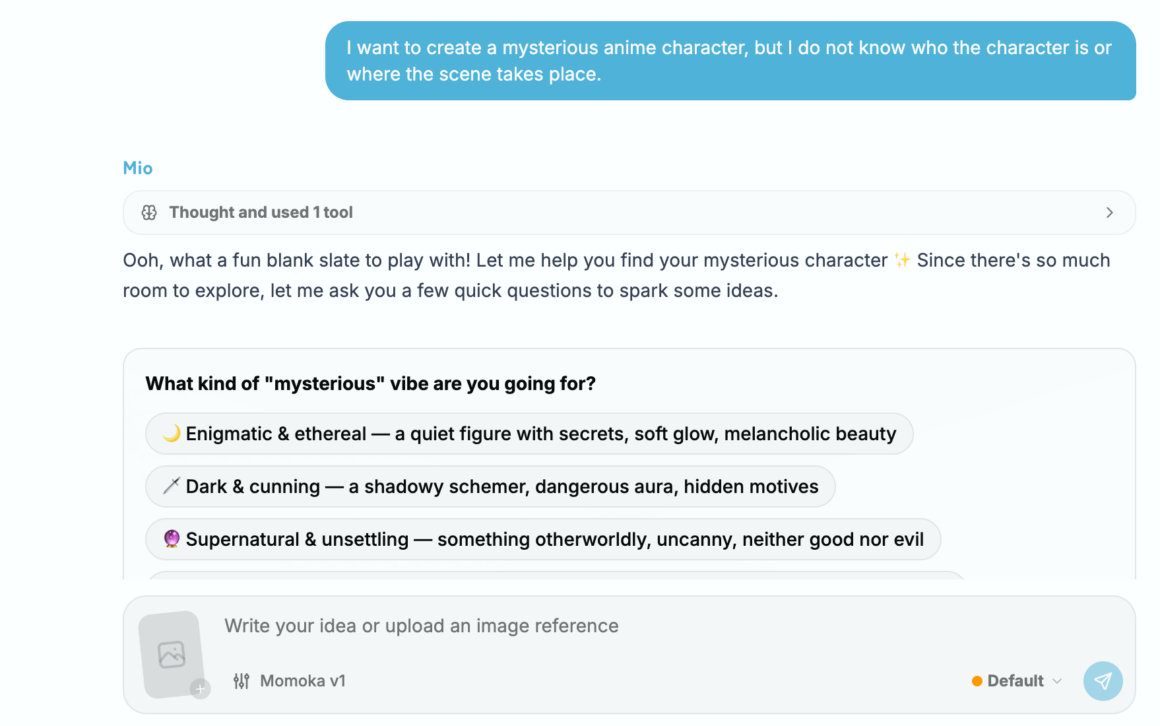
Caption: Starting with a vague idea in Mio.2. The first message does not need to be a finished Prompt.
Step 2 — Identify the Missing Creative Decisions
Turning a vague idea into a specific one means answering a short set of questions. These five come first:
- Who is the character?
- Where is the character?
- What is happening?
- What mood should the scene communicate?
- What should the viewer notice first?
Once those are settled, two supporting decisions follow: composition (how close the camera sits and what fills the frame) and lighting (what light source shapes the scene and what it does to the colour direction). They are supporting rather than primary because they express the first five rather than replace them.
Mio.2 can propose answers to any of these. Treat the suggestions as options to accept or reject, not as decisions already made. A concept you selected will hold together; a concept you accepted passively tends to drift once you start generating.
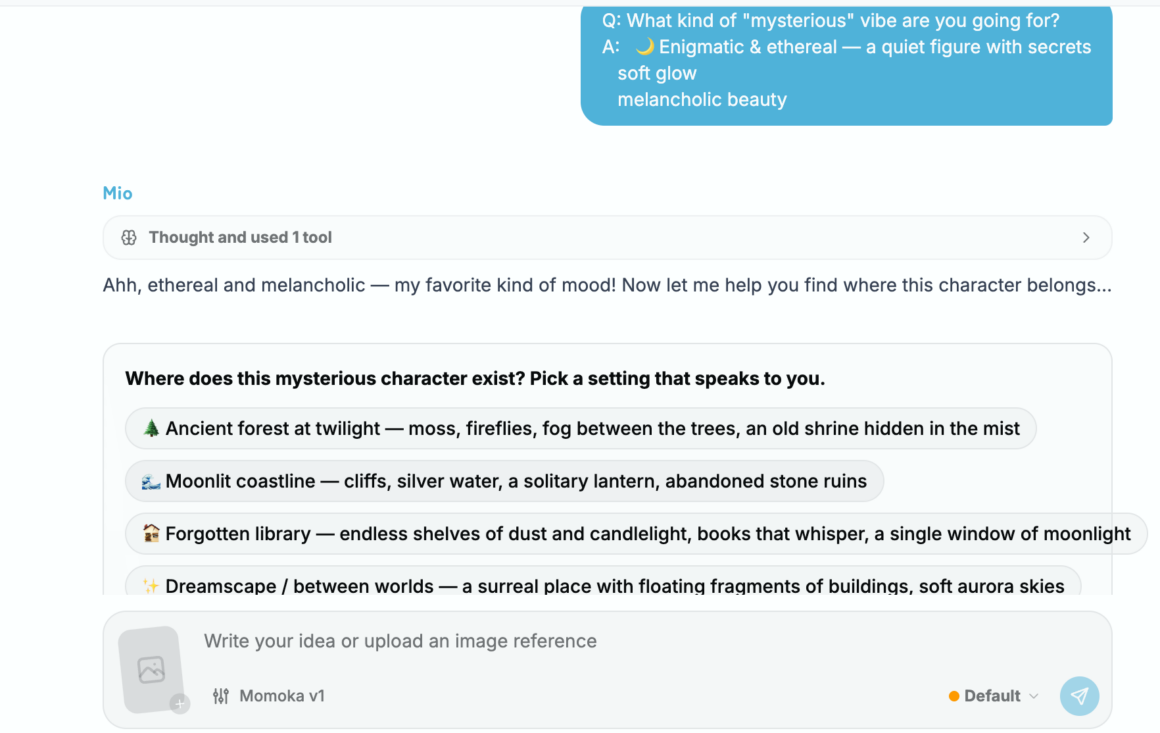
Caption: Mio.2 helps identify the creative decisions that are still missing from the initial idea.
Step 3 — Ask Mio.2 for Three Different Directions
Rather than committing immediately, ask for three concepts. Good anime prompt ideas usually come from comparing genuinely different options, not from refining the first one that appears.
Direction 1 — Moonlit Shrine Guardian. A supernatural guardian at an abandoned shrine, lit by blue moonlight, with glowing paper charms and an atmosphere of quiet tension.
Direction 2 — Cyberpunk Station Detective. An investigator alone in an empty neon station, holding a mysterious note, surrounded by reflective rain and suspense.
Direction 3 — Forgotten Greenhouse Alchemist. A young alchemist inside an overgrown glass greenhouse, tending glowing plants in dawn light, carrying wonder and isolation.
|
Concept |
Character Role |
Setting |
Mood |
Main Visual Motif |
|
Moonlit Shrine Guardian |
Supernatural guardian |
Abandoned shrine at night |
Quiet tension |
Glowing paper charms |
|
Cyberpunk Station Detective |
Investigator |
Empty neon train station |
Suspense |
Reflective rain and neon |
|
Forgotten Greenhouse Alchemist |
Young alchemist |
Overgrown glass greenhouse |
Wonder and isolation |
Luminous plants at dawn |
These are not variations of one idea. The role changes (guardian, investigator, alchemist), the setting changes (sacred, urban, botanical), the mood changes (tension, suspense, wonder), and the story context changes — protecting something, uncovering something, discovering something.
That is the standard worth holding. Three options that differ only in hair colour or outfit have not expanded anything.
Step 4 — Select and Expand One Concept
Take Moonlit Shrine Guardian forward.
Before writing the prompt, define the concept fully:
- Character role: a supernatural shrine guardian, not a visiting priestess
- Location: an abandoned mountain shrine at night
- Central action: the guardian stands beside a sealed shrine gate as several paper charms begin to glow
- Expression: alert and composed, attention directed toward the gate
- Story context: something behind the gate is stirring, and the guardian has noticed first
- Composition: medium-wide shot with the character as the main focus and the shrine gate visible behind them
- Lighting: blue moonlight from above, with warm light emitting from the charms
- Colour direction: cool blues and deep shadow, broken by pale gold
- Important details: worn shrine robes, sealed gate rope, drifting paper charms
The mood is quiet tension — the second before something happens, not action and not horror.
|
Starting Idea |
Refined Concept |
|
A mysterious anime character |
A supernatural shrine guardian |
|
Unknown setting |
Abandoned mountain shrine at night |
|
No action |
Standing beside a sealed gate as paper charms begin to glow |
|
Undefined mood |
Quiet tension |
|
No framing |
Medium-wide shot, gate visible behind the character |
Step 5 — Turn the Refined Concept into the Final Prompt
Build the prompt in this order: subject → role → setting → action → expression → composition → lighting → colour direction → visual style → supporting details.
Anime illustration of a young shrine guardian, a supernatural protector of an abandoned mountain shrine, standing beside a sealed wooden shrine gate at night as several paper charms begin to glow, alert and composed expression with her attention on the gate, medium-wide shot with the character as the main focus and the gate visible behind her, blue moonlight from above with warm light emitting from the charms, cool blue and deep shadow palette broken by pale gold, detailed anime style, worn shrine robes, sealed gate rope, drifting paper charms, still night air.
Reading it back against the concept:
- “young shrine guardian, a supernatural protector” controls the character.
- “abandoned mountain shrine at night” controls the setting.
- “standing beside a sealed wooden shrine gate as several paper charms begin to glow” controls the action.
- “blue moonlight… broken by pale gold” and “still night air” carry the mood.
- “medium-wide shot… gate visible behind her” controls the composition.
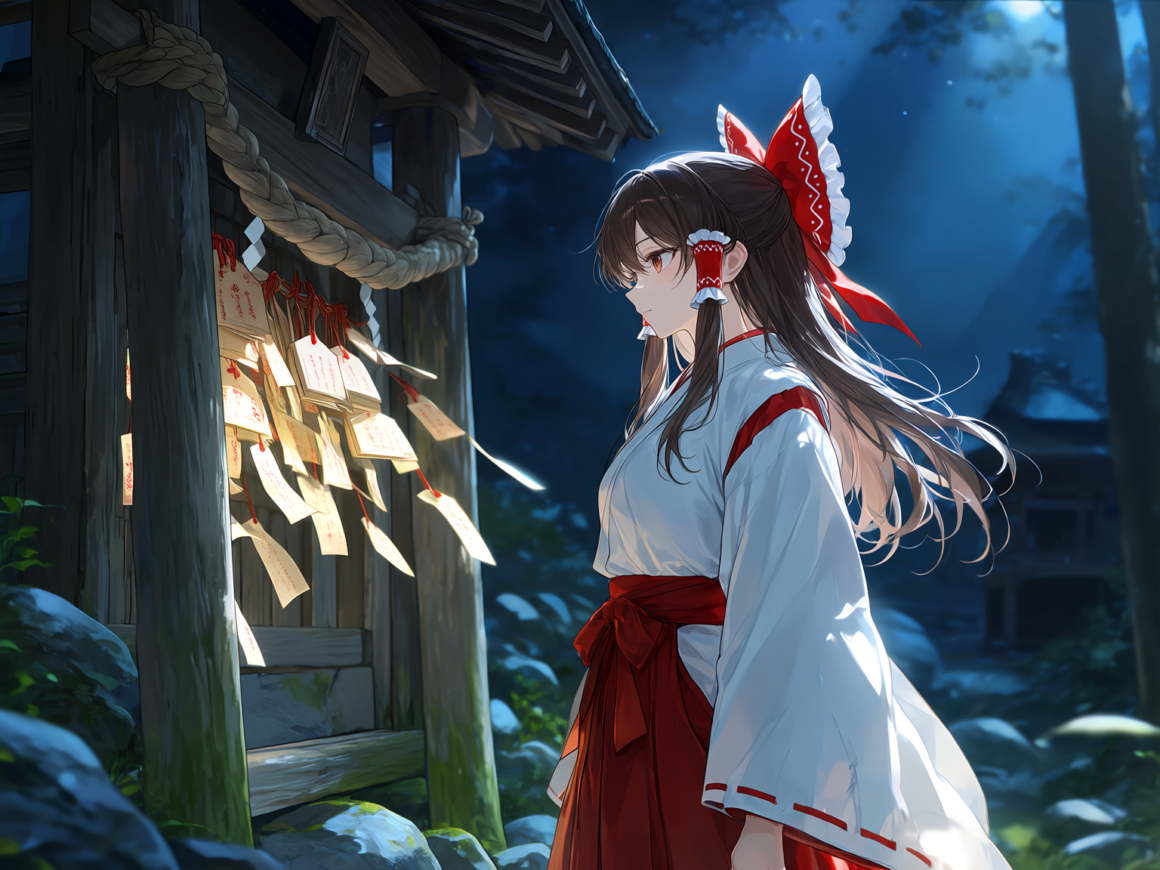
Check the result the same way: is the guardian the focus, is the gate readable behind her, are the charms glowing, and does the scene feel tense rather than dramatic?
This ordering suits this concept, but it is not a universal formula. Adding unrelated quality tags simply to lengthen the prompt can dilute the instructions that matter most.
What to Do If the First Result Misses the Idea
Revise one thing at a time. Pick a single issue — character role, setting, action, mood, composition, or visual motif — and leave the rest of the prompt untouched.
For example, if the paper charms barely read in the image, strengthen only that element: describe them as clearly glowing and drifting near the gate. If the background competes with the character, simplify only the background instead of rewriting the scene.
Changing four instructions at once produces a different image, but it does not tell you which change worked. The concept should stay stable while one instruction improves.
Conclusion
The process is short enough to remember: enter the idea, identify the missing decisions, create three directions, select one, then write the final prompt.
Clarifying before writing takes a few extra minutes and removes most of the guesswork afterwards. Take your next anime concept into Mio.2 and develop it the same way.
About the Author