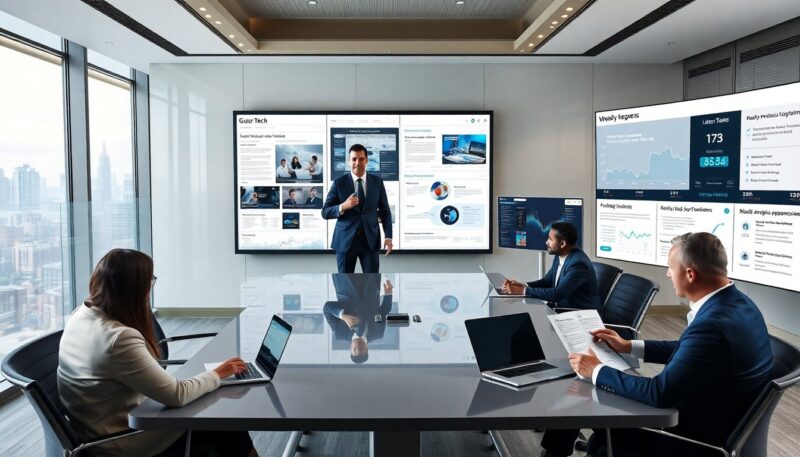
explore cutting wavetechglobal edge tech solutions at the start of a deployment planning process. The guide explains core features, use cases, and deployment steps. It outlines security practices and integration points. Readers get clear criteria for vendor selection and rollout planning.
Key Takeaways
- Explore cutting WaveTech Global edge tech solutions early in deployment planning to leverage their low-latency hardware, software, and managed services effectively.
- WaveTech Global’s edge solutions offer real-time telemetry, container orchestration, and hybrid cloud integration, simplifying adoption for diverse industries like manufacturing, telecom, retail, and healthcare.
- Use cases such as defect detection in manufacturing and real-time analytics in retail demonstrate measurable improvements in downtime reduction, latency, and customer experience.
- Secure deployments by implementing hardware root of trust, mutual TLS, network segmentation, and encrypted data flows to protect edge nodes and communications.
- Integrate WaveTech Global edge solutions with existing CI/CD pipelines and automate canary rollouts and health checks to minimize deployment risks and operational burdens.
- Evaluate total cost of ownership including hardware, connectivity, management, and indirect costs to choose between managed services or in-house models for your scale and skills.
What Sets WaveTech Global’s Edge Solutions Apart
WaveTech Global offers a combination of hardware, software, and managed services that target low-latency processing. The company places compute close to data sources to reduce round-trip time. Their appliances include field-hardened nodes and compact servers that run containerized workloads. The software includes an orchestration layer that schedules workloads based on latency and bandwidth needs. The platform exposes APIs that let developers push functions to edge nodes quickly. WaveTech Global adds built-in telemetry that reports device health and application performance in real time. The vendor provides a managed option that handles updates, patching, and lifecycle management. The managed option reduces operational burden for teams with small ops staff. WaveTech Global also supports hybrid models that keep control planes in private clouds and place data planes at customer sites. The vendor documents standard integration patterns for existing cloud providers and common enterprise stacks. Buyers get reference architectures and deployment scripts that cut planning time. They also get a developer kit that includes SDKs, sample workloads, and CI/CD templates. The vendor publishes performance baselines for typical workloads such as video analytics and predictive maintenance. These baselines let teams set measurable goals for latency and throughput. The combination of hardware, software, and services makes WaveTech Global easier to adopt for teams that need fast results and lower initial risk.
Key Use Cases And Industry Applications
Edge computing fits use cases that require local processing, low latency, or data reduction. WaveTech Global targets manufacturing, telco, retail, and healthcare sectors. In manufacturing, the platform runs machine-vision models on the factory floor to detect defects. The solution reduces defect rates and lowers scrap costs. In telecommunications, providers run virtual network functions at base stations to improve service quality. The approach lowers user-plane latency for real-time services. In retail, stores run real-time analytics for foot-traffic and inventory tracking at the edge. Retailers reduce overstock and increase shelf availability. In healthcare, clinics host clinical decision support close to the point of care to speed diagnostics. The setup improves response times for critical applications and keeps patient data local when required.
Real-World Implementation Examples And Results
A manufacturing customer deployed WaveTech Global nodes across three plants. They ran an anomaly detection model on vibration data at the edge. The deployment detected failing bearings two weeks earlier than the previous schedule. The customer reduced unplanned downtime by 38%. A regional telecom operator deployed the platform at 150 cell sites. They ran a user-plane function at each site and shifted traffic locally for voice services. The operator observed a 22% drop in perceived call latency. A retail chain installed edge nodes in 120 stores for video-based queue analysis. The chain reduced average checkout wait time by 14% and increased conversion rate during peak hours. These examples show measurable gains when teams place processing where data originates.
Deployment Considerations: Architecture, Security, And Integration
Teams should design an architecture that separates control and data planes. They should run orchestration in a central cloud and place data processing at edge nodes. This design keeps centralized policy control while enabling local decisions. Teams should choose node hardware based on workload CPU, GPU, and I/O needs. They should size storage for short-term buffering and for local model caching.
Teams should secure devices with hardware root of trust and firmware signing. They should enable secure boot so devices run only approved images. They should use device certificates and mutual TLS for node-to-cloud communication. They should segment networks so management traffic uses a separate VLAN from application traffic. They should encrypt data at rest and in transit. They should carry out role-based access control for management consoles and APIs.
Teams should integrate WaveTech Global with existing CI/CD pipelines. They should containerize workloads and use the vendor’s orchestration plugins. They should automate canary rollouts and health checks to reduce deployment risk. They should collect logs and metrics centrally for long-term analysis and send only aggregated data to central systems to reduce bandwidth costs.
Teams should plan for lifecycle operations. They should schedule regular maintenance windows for firmware and model updates. They should use the vendor’s managed services if they lack on-site staff. They should run pilot projects on a limited number of sites to validate performance and procedures. Pilots should include clear success metrics such as latency targets, throughput, and mean time to repair. Teams should document runbooks for common failure modes and train operations staff on recovery steps.
Finally, teams should evaluate total cost of ownership across hardware, connectivity, and management. They should include indirect costs such as power, rack space, and site access fees. They should compare a managed subscription against an in-house model. This comparison helps teams choose the most cost-effective path for their scale and skills.
About the Author